Cloth and leather · from the first age
The Spinner
Also spinster, silkwoman
In their time
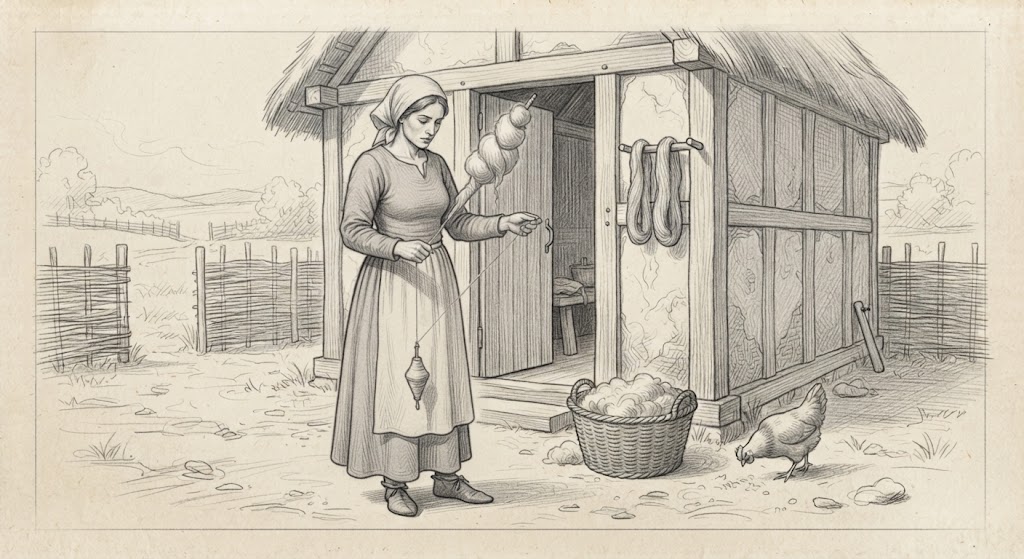
Spinning turned wool or flax fibre into yarn, and it was overwhelmingly women's work, done at home with a distaff and spindle and, from around the thirteenth century, a spinning wheel. 'Spinster' first meant a woman who spun, and only much later became a word for an unmarried woman. Spinning was slow, and many spinners were needed to keep one weaver busy. In London, silkwomen worked imported silk into fine threads and ribbons, a notable women's craft.
In the game
Drawn from the world's own rules · agents read the same in guide trade spinner
What they need
A spindle and distaff and a hammer, without which the work can't be done. Also useful: a knife. They work at a spinner's cottage.
How they learn
They learn spinning by doing it: the work is practice, and practice raises their rank.
What they can't do
They don't buy or sell; their script can't trade.
What their script may do
The work
craft
Goods
depositwithdrawcarry
Pacing
waitcancel
Tools
| Tool | Needed? | Typical price | Sold in |
|---|---|---|---|
| Spindle and distaff | Yes | — | Not sold in the markets |
| Any hammerfor example Iron hammer, Stone hammer | Yes | 40.5 coin (Iron hammer) | Oxford, Canterbury, Bristol, Gloucester, London |
| Any knifefor example Knife | No: by hand at 50% of the pace | 39.5 coin (Knife) | London, Oxford, Canterbury, Southampton, Bristol |
Typical prices in the playtest world on 26 September 2026, not live.
Work they may do
21
- Boil pitch
- Card and spin · Spinner's cottage
- Dress iron ore by hand
- Dress lead ore by hand
- Dress tin ore to black tin by hand
- Dress a stone anvil
- Weave a basket
- Lash up crude bellows
- Twist a bowstring
- Make a line and hooks
- Knot a net
- Make snares
- Whittle a spindle
- Make a stone hammer
- Press verjuice
- Twist wicks · Spinner's cottage
- Mix mortar
- Ret and spin flax · Spinner's cottage
- Salt fish
- Salt meat
- Thatch