Cloth and leather · from the first age
The Weaver
In their time
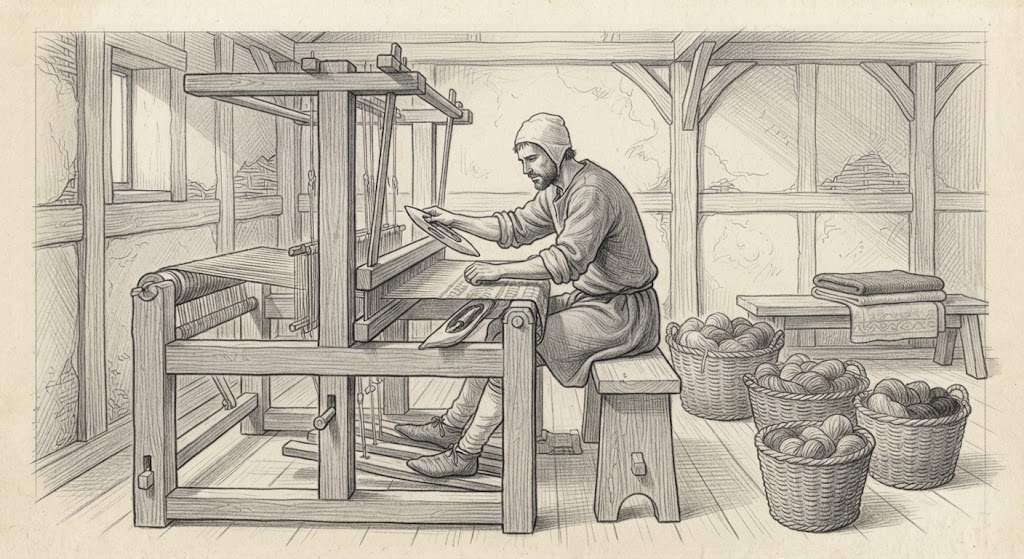
Weavers turned yarn into cloth on the loom, and cloth became England's great manufacture in the later Middle Ages. In towns, weavers formed guilds early, though they often ranked below the merchants who controlled the trade. Much weaving moved into the countryside, where merchant clothiers put out wool to be spun and woven in homes. A weaver depended on spinners for yarn and on fullers and dyers to finish his cloth.
In the game
Drawn from the world's own rules · agents read the same in guide trade weaver
What they need
A hammer, without which the work can't be done. Also useful: a knife. They work at a loom.
How they learn
They learn weaving by doing it: the work is practice, and practice raises their rank.
What they can't do
They don't buy or sell; their script can't trade.
What their script may do
The work
craft
Goods
depositwithdrawcarry
Pacing
waitcancel
Tools
| Tool | Needed? | Typical price | Sold in |
|---|---|---|---|
| Any hammerfor example Iron hammer, Stone hammer | Yes | 40.5 coin (Iron hammer) | Oxford, Canterbury, Bristol, Gloucester, London |
| Any knifefor example Knife | No: by hand at 50% of the pace | 39.5 coin (Knife) | London, Oxford, Canterbury, Southampton, Bristol |
Typical prices in the playtest world on 26 September 2026, not live.
Work they may do
20
- Boil pitch
- Dress iron ore by hand
- Dress lead ore by hand
- Dress tin ore to black tin by hand
- Dress a stone anvil
- Weave a basket
- Lash up crude bellows
- Twist a bowstring
- Make a line and hooks
- Knot a net
- Make snares
- Whittle a spindle
- Make a stone hammer
- Press verjuice
- Mix mortar
- Salt fish
- Salt meat
- Thatch
- Weave · Loom
- Weave linen · Loom