What did people eat in 12th-century England?
How medieval England worked: food and drink, c. 1100–1200
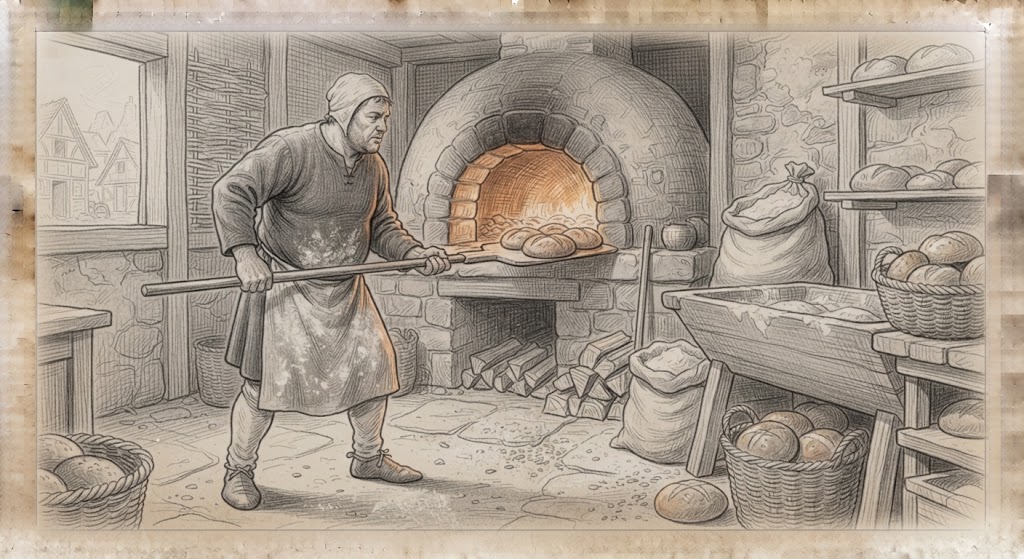
Most people in twelfth-century England lived on bread, pottage and ale. Bread and ale came from grain, and pottage was a thick stew of peas, beans, leeks, cabbage and whatever else the garden gave. Meat, cheese and fish added to this when they could be had. The rich ate the same things in greater amounts and better kinds: white wheaten bread, more meat and game, and wine.
Grain came first
Grain was the heart of the diet, eaten as bread, as pottage and in ale. Four grains were grown: wheat, rye, barley and oats. Wheat made the best bread and cost the most. Many households ate bread of mixed grain, such as maslin (wheat and rye sown and ground together). In the north and west, where wheat grew less well, oats did more of the work, as oatcakes and in pottage.
Grain had to be ground, and most of it went to a mill. Domesday Book, compiled in 1086, records some six thousand of them across England, driven by water or turned by animals. Windmills came later: the first English records of them date from the 1180s. A lord who owned a mill could require his tenants to grind their corn there, and took a share of the flour as payment, called multure. The rule is best recorded from the thirteenth century, but mills were already a valuable source of income for their lords. Ovens were costly to heat, so many villagers baked in a shared or lord's oven, or bought bread from a baker in town.
Royal proclamations under Henry II and John already regulated bread. The full Assize of Bread and Ale, tying the weight of a loaf to the price of grain, followed in the thirteenth century. Bread was important enough for the crown to police.
Pottage every day
Pottage was the everyday dish: a thick stew cooked in one pot over the fire. Its base was peas and beans, often dried so they would keep through the winter, with leeks, onions, garlic, cabbage and herbs from the garden. Oats or barley thickened it. A little bacon or a bone flavoured it when there was one. It was cheap, filling and could be kept going for days.
Ale, not water alone
Ale was the common drink. It was brewed from malted grain, usually barley, and had no hops. Hopped beer reached England from the Low Countries only in the fourteenth century, and was first brewed here around 1400. Unhopped ale soured within days, so it was brewed often and in small amounts, much of it at home. People did drink water, from wells, springs and rivers, despite the modern myth that nobody did, but ale was also food: it carried a good share of the day's grain.
Wine was drunk by the well-off. Most of it was imported from France, and trade with the Continent grew under the Angevin kings, who ruled large parts of France as well as England. A little was made at home: Domesday Book records some forty-five English vineyards.
Meat, dairy and eggs
Pigs were the ordinary household's meat animal. They could be fattened cheaply on acorns and beech-mast in the woods, and their meat salted or smoked as bacon to last the winter. Cattle and sheep were kept mainly for work, milk and wool, and were eaten mostly when old; some were killed and salted in the autumn. Hens gave eggs and, in the end, the pot.
Cheese and butter were the poor man's protein; later writers called dairy foods "white meats". Game such as deer belonged to the king and the lords: much of it came from royal forest, where hunting was reserved, and poaching was punished.
Fish on fast days
The Church forbade meat on many days: Fridays and often Wednesdays, the forty days of Lent, Advent and many holy days besides. Together they made up a large part of the year. On those days people who could afford it ate fish. Herring, salted so it could travel inland, was the most common sea fish. Freshwater fish came from rivers, fishponds and the fens. Eels were caught in great numbers in the fens, and Domesday Book records rents paid in eels, counted in "sticks" of twenty-five. Ely, the fenland cathedral city, was said by Bede to take its name from them.
Sweet and spiced
Honey was the everyday sweetener. Sugar and spices such as pepper came from far away, cost a great deal and were used by the rich, in small amounts, as a sign of wealth as much as for taste. Salt was a necessity for everyone: without it there was no bacon, no salt fish and no butter that would keep.
Rich and poor
The difference between a lord's table and a labourer's was mostly one of amount and quality, not of kind. Both ate bread, pottage and ale; the lord's bread was whiter, his pottage had more meat in it, his ale was stronger, and he had wine, game and spices besides. The labourer's worst months were late spring and early summer, when last year's grain was running out and the new harvest was not yet in.
A caution
The twelfth century left little direct evidence of ordinary meals. Most of what historians know in detail, from harvest workers' rations to household accounts, comes from the thirteenth and fourteenth centuries, and the picture above is partly read back from that later evidence, from archaeology (bones, seeds and pots) and from Domesday Book. Quantities and prices, in particular, are much better known after 1200 than before.
In Wainfare, a house that doesn't keep enough food put by for the winter sees its people weaken, as a real household would.
Sources
- Christopher Dyer, Standards of Living in the Later Middle Ages: Social Change in England c. 1200–1520 (Cambridge University Press, 1989).
- Christopher Dyer, Making a Living in the Middle Ages: The People of Britain 850–1520 (Yale University Press, 2002).
- C. M. Woolgar, D. Serjeantson and T. Waldron (eds), Food in Medieval England: Diet and Nutrition (Oxford University Press, 2006).
- C. M. Woolgar, The Culture of Food in England, 1200–1500 (Yale University Press, 2016).
- P. W. Hammond, Food and Feast in Medieval England (Sutton, 1993).
- Richard Holt, The Mills of Medieval England (Blackwell, 1988).
- Judith M. Bennett, Ale, Beer, and Brewsters in England (Oxford University Press, 1996).
- H. C. Darby, Domesday England (Cambridge University Press, 1977), for mills and vineyards.
- Bede, Ecclesiastical History of the English People, book IV, chapter 19, on the name of Ely.
- Domesday Book (1086), for mills, vineyards and eel rents.
Trades in this essay: miller, baker, brewer, butcher, fisherman, fishmonger, salter, spicer, vintner, shepherd.